

Understanding the customer journey still matters, but the conversation has moved beyond simple funnel thinking. Businesses now need to understand not only how customers move from awareness to purchase, but also what happens after the sale and how those later stages affect loyalty, retention and advocacy.
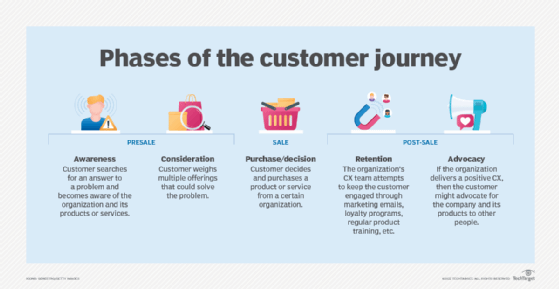
The core customer journey phases still provide a useful framework: awareness, consideration, purchase, retention and advocacy. Different organizations may label them differently, and customers may enter at different points, but the broader pattern remains the same.
The journey is not always linear, though. Customers may move backward, skip stages or revisit earlier questions as new stakeholders, new information or new priorities emerge.
Explore the five main customer journey phases and what consumers need to know in each one.
Retention is also typically more cost-effective than acquisition. If organizations can reduce churn, improve support and help customers see ongoing value, they are more likely to keep that business and build the foundation for advocacy later.
1. Awareness phase
Most prospective customers start at the awareness phase, where a user has a problem or need and looks for an answer. At this stage, customers are usually trying to understand a problem and what kinds of solutions might address it.
These customers prefer educational thought leadership over promotional or product-oriented insights, so organizations shouldn’t aggressively push products on customers. Instead, marketing teams can show how their offerings can address customer needs, like listing benefits.
Common approaches in this phase include educational content, search visibility, thought leadership and other materials that help customers make sense of their problem before they are ready to evaluate vendors.
2. Consideration phase
During the consideration phase, customers compare one organization’s offerings to competing options. Blog content, case studies, email nurturing and webinars can all help organizations continue engaging with prospects.
At this stage, the tone usually shifts from broad education to more detailed explanations of fit, value and differentiation. As CX teams engage with customers, they can also reinforce how products and services work in practice and where they solve real problems.
Ultimately, if marketing teams can address major issues that prospects have, they can help move those consumers into the next customer journey phase. Marketing teams must change content tone and messaging in this phase from high-level and educational to a more detailed approach.
Where the customer journey usually gets overlooked
Many businesses spend the most time on the first three journey phases — awareness, consideration and purchase — because those stages are closest to marketing and sales goals. The later stages often get less attention, even though retention and advocacy are where the long-term value of the relationship is tested.
That is where onboarding, support, communication and follow-up matter most. If the post-sale experience is weak, the earlier stages of the journey may still produce a sale, but they will not produce loyalty.
3. Purchase/decision phase
The first three phases usually involve the closest coordination between marketing, sales and presales teams. By the purchase or decision phase, customers often have a short list of options and are looking for proof, confidence and clarity.
Sometimes, people enter the customer journey in this phase if they initially request demos, ask for quotes or want to speak to a sales representative. These individuals may fill out a business’s contact form or other conversion points lower in the sales funnel, including a paid campaign that targets the bottom end of the funnel.
People at this stage commonly have a short list of companies they would buy from, so a good sales process and successful case studies give an organization an edge over its competition. An introduction to an existing customer as a reference also enables discussions between peers outside of the sales process. And, within the sales process, good relationships and rapport can set brands apart.
4. Retention phase
In many cases, the first few weeks after the sale do a lot to determine whether the customer moves toward retention or starts drifting toward frustration.
The last two phases of the customer journey happen after the sale, which is where many organizations still fall short. A purchase does not end the journey. In many cases, it is where the harder work begins.
Retention depends on whether customers can adopt the product, get value from it and resolve problems without unnecessary effort. That means onboarding, support, knowledge, training and regular communication all play a bigger role than many companies assume.
In this phase, organizations may offer training, FAQs, product updates, customer success programs, loyalty initiatives or proactive check-ins. The goal is not just to stay visible. It is to help customers succeed and reduce the chances that confusion, poor support or low adoption undermine the relationship later.
5. Advocacy phase
Advocacy comes after strong customer experience, not before it. Customers who consistently get value from a product or service, and who feel that the company understands their needs, are more likely to recommend that brand to others.
This is one reason expectations set during onboarding and early product use matter so much. If customers can recognize progress, measure success and feel supported over time, they are more likely to become references, case-study participants or informal promoters through word of mouth.
Organizations can also gauge advocacy through reference participation, feedback conversations and tools such as Net Promoter Score. These signals can help teams understand not only whether customers are satisfied, but why they are willing — or unwilling — to speak positively about the brand.
Key takeaways
The five journey phases still offer a useful framework, but businesses should not treat them as a simple funnel that ends at purchase. Retention and advocacy are just as important to the overall customer experience (CX), especially in subscription, service and long-term account relationships.
Teams that understand how customer needs change at each stage can align content, support, communication and service more effectively. They can also see where expectations break down across the full lifecycle, not just before the sale.
The customer journey is not static. As products, channels and customer expectations change, businesses need to revisit these phases and adjust how they support customers from first touch through ongoing use and follow-up.
Editor’s note: This article was originally published in 2022 and updated in April 2026 to reflect current thinking on customer journey phases across presale and post-sale experience.
Griffin LaFleur is a MarketingOps and RevOps professional working for Swing Education. Throughout his career, LaFleur has also worked at agencies and independently as a B2B sales and marketing consultant.


