
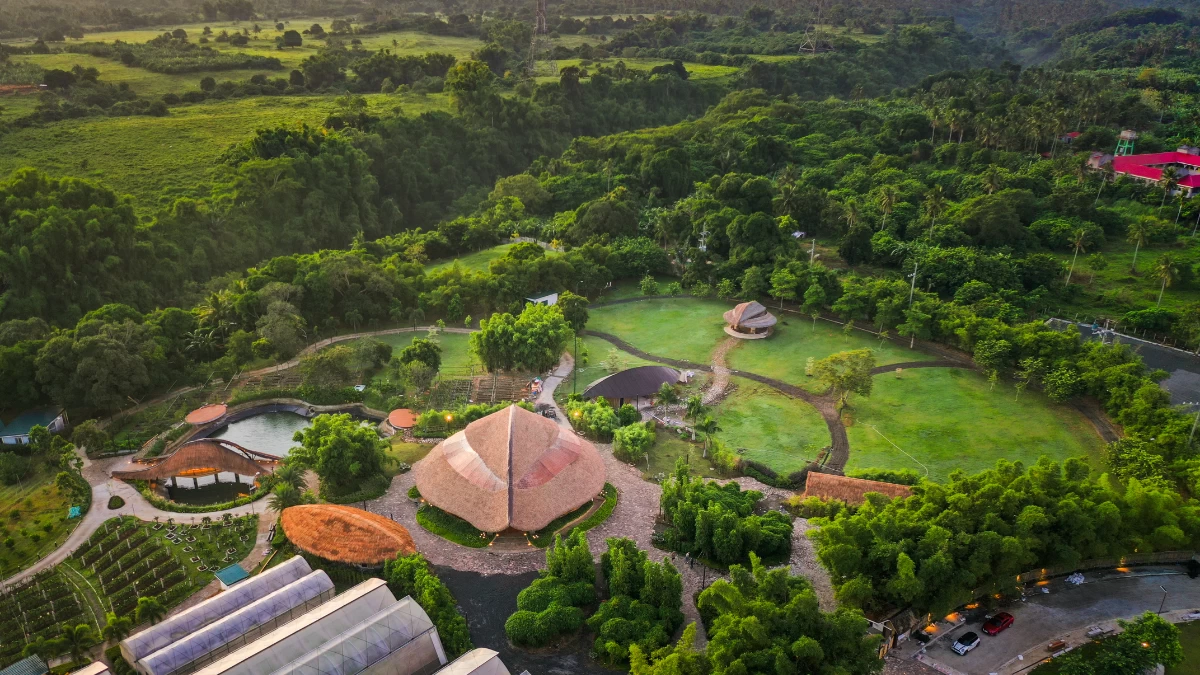
As one of Time Magazine’s World’s Greatest Places of 2026, Kaway’an EcoPark joins the coveted global list of extraordinary destinations featuring groundbreaking bamboo ecotourism. Located at Sabella Village in General Trias City, Cavite, the three-hectare eco-park was built by Citihomes Builder and Development Inc. (CBDI), a legacy project of Rosie Tsai, president of CBDI, in response to the country’s need for spaces that nurture both people and the land. The eco-park formally opened in July 2025. More than a leisure destination, the master-planned eco park offers an immersive journey to the natural world of water features, foliage, and open spaces. Rather than a mere series of attractions, visitors can go through pathways that flow organically through a man-made lagoon, gardens, and bamboo groves that lead to remarkable bamboo structures. The Kaway’an EcoPark takes the lead in charting a bold new course for sustainable architecture, showcasing what bamboo can achieve as a structural material. At the heart of the eco-park stands the Marilag Grand Pavilion, an architectural centerpiece made with treated bamboo. Wide spans are achieved using shape instead of weight, with bamboo mainly handling pressure and bending, creating a very strong structure against tropical weather while also being open, airy, and visually stunning. “Traditionally, the bamboo represents the resilience and perseverance of the Philippine spirit. It bends under the strong winds of life’s trials but rises again with strength and determination,” explained Tsai. “Now, we have to break the wrong notion that bamboo is a poor man’s lumber. When it’s embedded in concrete and protected from rain and sun, bamboo is stronger than steel and will not rot as long as it’s treated.” She also cited bamboo as environmentally friendly, producing more oxygen and sequestering seven times more carbon dioxide than trees, and sustainable, growing faster in clumps and being harvest-ready only after three years. Despite the extra costs of shipping bamboo poles from Bali and the lack of local builders who are willing to work with treated bamboo, the developer pushed the creation of the pavilion through a unique partnership between Filipino architect Christian Salandanan and international bamboo experts, led by Elora Hardy from IBUKU Studio, Indonesia; Orin Hardy from PT Bamboo Pure, Indonesia; and Niel Thomas from Atelier One, United Kingdom. Together with 16 Balinese bamboo artisans, they worked on thousands of giant bamboo poles imported from Indonesia. Complementing the pavilion is the Marahuyo Bridge, which shares the same philosophy of wide-span bamboo construction, calibrated to meet modern performance standards while retaining visual lightness. Together, these structures respond naturally to climate, airflow, and movement—designed to flex, breathe, and endure in harmony with their tropical surroundings. CBDI Arch. Brian Everett Raduban designed auxiliary bamboo structures, including the mini pavilion, guest lounges, and restrooms. Thus, aside from leisure visitors, young architects and students come in droves to admire the architectural structures. And they have more attractions to look forward to since construction of Phase 2 is about to begin in the coming months. “We’re adding glamping huts, a treetop adventure with hanging bridges, and a zip line. From seven species of bamboo, we’re also planting three more varieties,” added Tsai. With the spotlight brought by the eco park while leveraging her experience working with the government, she is also hopeful that bamboo will soon be formally recognized and added as an alternative to lumber in the National Building Code of the Philippines. “Once it’s approved, we can bring bamboo to mass housing. Currently, the country can produce engineered bamboo for flooring, but all of it is exported. It’s a missed opportunity for us since we’re using our natural resources. We should use our natural resources for our own domestic use, especially for those who need housing,” said Tsai.
Kaway’An EcoPark: a showcase of architectural ingenuity using bamboo
Source: Manila Bulletin
Read Full Story →