
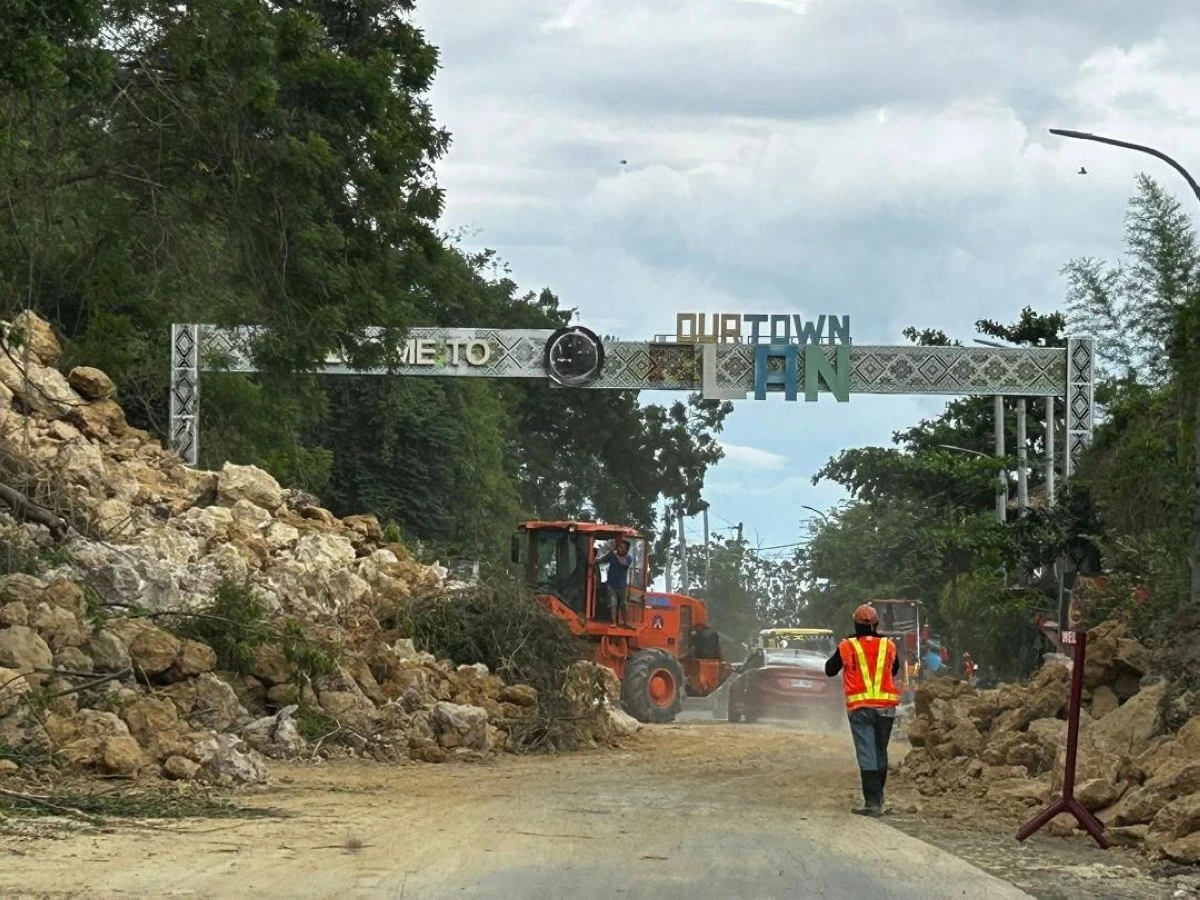
A hazardous geological phenomenon known as “artificial river damming” now threatens downstream communities in Mindanao after a massive magnitude 7.8 earthquake in Maasim, Sarangani last week destabilized mountain slopes, triggering massive landslides that have choked local river channels. This was revealed by the Office of Civil Defense (OCD) during a press conference on Monday, June 15, where updates on the aftermath of the powerful temblor that shook Mindanao last June 8 were provided by concerned government agencies. According to the Department of Environment and Natural Resources-Mines and Geosciences Bureau (DENR-MGB), the seismic shaking from the main shock in Maasim, Sarangani has left mountain slopes highly unstable, setting the stage for a secondary disaster as rain begins to fall. “The earthquake on June 8 caused instability in mountain slopes. Because the slopes are already unstable, when it rains, it can trigger larger landslides,” said DENR-MGB senior geologist Dr. Kevin Garas. He warned that the disaster is transitioning from earthquake-induced landslides into rain-induced landslides, creating high-risk blockages in local waterways. “The landslide debris went into the river and cut off the channels [of water]. That cutoff produced an artificial dam,” Garas explained. “When it rains, the water level can rise. If the dam breaches, it can cause flooding, flash floods, or even debris flow in adjacent municipalities along that river channel and downstream communities.” To prevent a catastrophic breach, the MGB and the Philippine Institute of Volcanology and Seismology (PHIVOLCS) are utilizing aerial surveys and ground assessments to locate these landslide dams and map out potential flash flood scenarios, ensuring that vulnerable communities are warned well in advance so they can evacuate. 736K individuals affected, 65 dead, 36 missing, thousands hurt The emerging environmental threat complicates an already massive humanitarian crisis as the OCD reported that the powerful earthquake has affected 176,186 families or 736,386 individuals across 512 barangays across four regions: Zamboanga Peninsula (Region 9), Davao (Region 11), Soccsksargen (Region 12), and Bangsamoro Autonomous Region in Muslim Mindanao (BARMM). The death toll has reached 65 individuals, with 57 fatalities recorded in Region 12 and eight in Region 11. Additionally, 1,447 people were injured, and 36 remain missing. Damage to infrastructure reached P1.13 billion, with 728 public and private infrastructures damaged—prompting 14 local government units to declare a state of calamity. The search for the missing has taken a grim turn in the hardest-hit zones, particularly in Jose Abad Santos, Davao Occidental where 18 people remain unaccounted for after entire hillsides collapsed. “Bulk of the reported missing are from Jose Abad Santos due to landslide. We have one barangay (Patulang) where 10 people were reported missing, seven of those are from a single household that was buried by a landslide,” said OCD Assistant Secretary Bernardo Rafaelito Alejandro IV. Alejandro, who visited the site, confirmed that rescue teams in one specific area had to call off operations because an entire mountain had collapsed, rendering heavy machinery useless and manual digging impossible. Resources have since been channeled to relief operations. “We are trying hard to recover the bodies. We’re working with the LGUs, the mayors there, and if there is a need to continue digging, we will continue,” Alejandro said, confirming there are currently no signs of life among those buried. He noted that the majority of the 65 fatalities died due to earthquake-induced landslides, while others in General Santos City, Glan (Sarangani), and Jose Abad Santos lost their lives due to falling debris. Search, rescue, and retrieval ongoing Down on the ground, the Armed Forces of the Philippines (AFP) mobilized 43 search, rescue, and retrieval (SRR) teams comprised of 546 personnel and deployed 33 land assets and six aircraft for humanitarian assistance and disaster response (HADR) operations. An additional 183 SRR teams, 1,478 personnel, 213 land assets, three air assets, and seven naval assets remain on standby. “All hands on deck here. As long as needed, the entire AFP is willing to augment these operations being conducted,” Padilla said. Learners affected The OCD said that the structural damage extended heavily to the education sector, where schools have been destroyed or rendered unsafe, disrupting classes for thousands of students. The earthquake occurred on the first day of classes in many public schools in Mindanao. “We’re working with DepEd [Department of Education]. We are fast-tracking the repairs of totally destroyed and partially damaged school buildings. At the same time, we are helping DepEd facilitate the establishment of temporary learning facilities to replace classrooms. They are adjusting schedules and modes of delivery of classes in areas that are really affected ,” Alejandro said. Shaking continues Meanwhile, Department of Science and Technology (DOST) Director Teresito Bacolcol reported that seismologists have logged 6,144 aftershocks since the initial disaster. Of these, 78 were strong enough to be felt by residents, with the largest peaking at a magnitude 6.4 tremor that struck hours after the main June 8 shock. A total of 57,252 houses were damaged across the affected regions — 47,229 partially and 10,023 totally destroyed. According to DSWD Disaster Response Management Bureau Director Maria Isabel Lanada, families who initially sought shelter outside evacuation centers (ECs) with relatives or in makeshift shanties are now flooding into formal government camps. “Those outside ECs who were staying with friends and relatives or made makeshift shanties are returning and going to evacuation centers. The intervention of the local government is good, and those outside prefer to stay inside because of the complete facilities and the food and non-food items we distributed,” she said. To date, 3,180 families or 14,161 persons were being sheltered inside 37 evacuation centers while 14,687 families or 59,013 persons were receiving aid outside the centers. The DSWD has already distributed 125,242 family food packs, 7,428 ready-to-eat meals, and 6,990 non-food items to affected communities. Through the Assistance to Individuals in Crisis Situations (AICS) program, the agency has also released P36,675,000 in direct financial aid to affected families, focusing on those hospitalized or grieving the deceased. The total DSWD assistance cost has reached P124,946,118.48. Recovery on the way OCD Administrator Usec. Harold Cabreros emphasized that rehabilitation will require prolonged and unified action from all government agencies. “The government is addressing all the needs of our victims, especially those in affected areas. It’s a whole-of-society approach,” Cabreros said. “We also recognize the assistance and support from civil society organizations, NGOs, and even international organizations. This disaster is being addressed collectively to help our countrymen, and our assistance will continue until the condition of the earthquake victims normalizes.”
‘Landslide dams’ threaten Mindanao towns as quake aftermath alters river ecosystems
Source: Manila Bulletin
Read Full Story →